What Moves the Price of Gold?
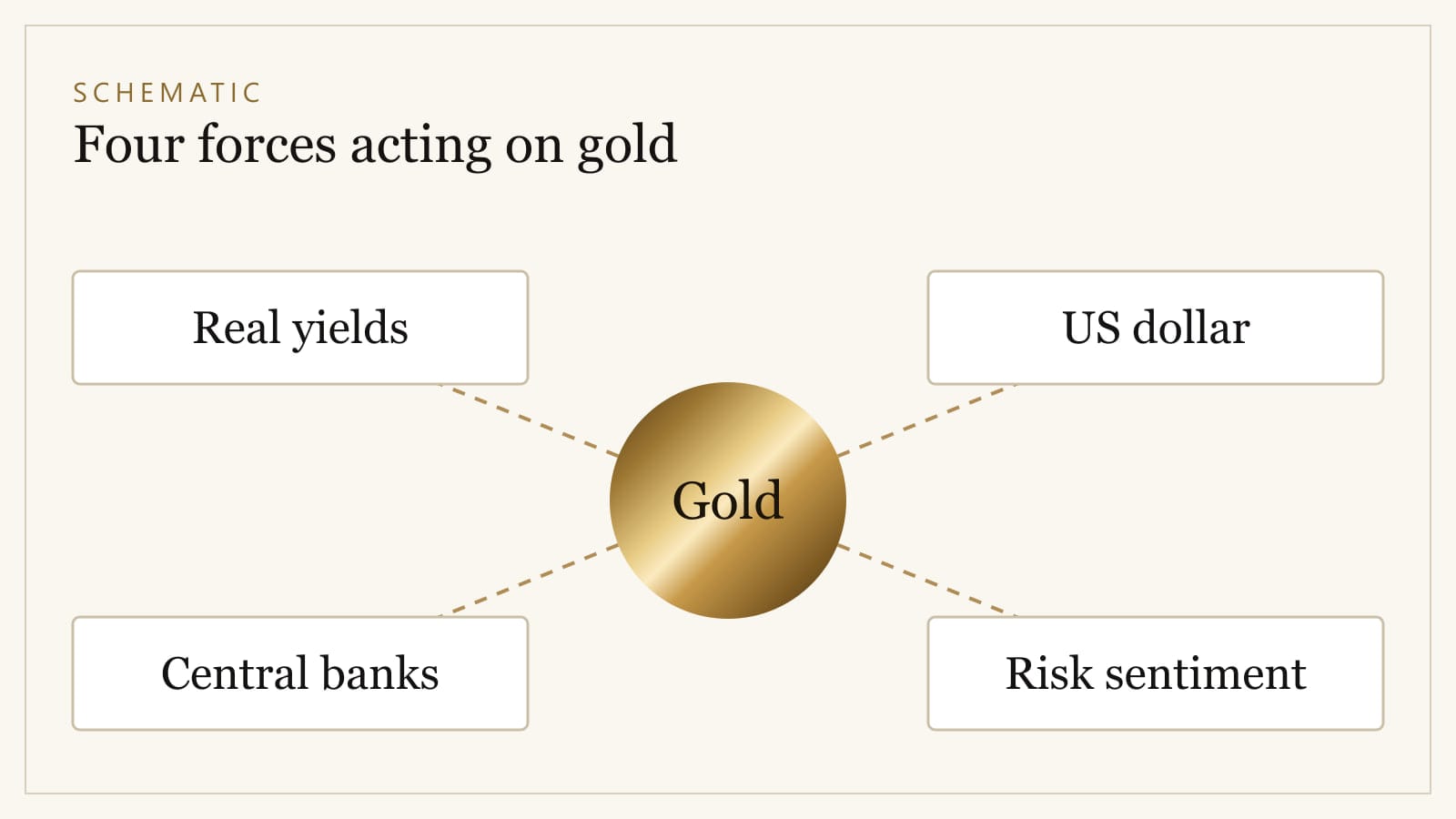
Gold has no earnings, no coupon and no central bank. Its price is set by a handful of forces that often disagree with each other, which is exactly why simple explanations fail.

Key takeaways
- Gold pays no income, so rising real interest rates have tended to make it less attractive and falling real rates more attractive.
- Gold is priced in dollars, so dollar strength and weakness show up directly in the XAUUSD quote.
- Central banks and physical demand can move gold for reasons that have nothing to do with a chart.
- Gold's safe-haven reputation is real but inconsistent: in a rush for cash it can be sold like anything else.
- These are tendencies, not rules. Single-cause explanations of a move are usually written after it happened.
In this article · 9 sections
The short answer
The price of gold is moved mainly by real interest rates, the US dollar, central bank buying and selling, physical and investment demand, and risk sentiment. On any given day these forces can push in opposite directions, so the price reflects whichever is dominant at that moment — and that changes.
Real interest rates: the cost of holding something that pays nothing
Gold produces no income. A bond pays interest; a share may pay a dividend; a bar of gold simply sits there. So the decision to hold gold always carries an opportunity cost: the return you could have earned instead.
The version of that cost that matters is the real interest rate — the yield on a safe bond after inflation is taken into account. When real yields rise, holding gold means giving up more, and demand has tended to soften. When real yields fall, or turn negative, the cost of holding gold shrinks and it becomes relatively more attractive.
This is the most widely cited driver of gold, and it is also a good example of why no driver works as a law. The relationship has held for long periods and weakened noticeably in others, often when a different force — such as heavy central bank buying — was strong enough to overwhelm it.
The US dollar
Gold is priced in dollars around the world. That creates two separate effects, and it helps to keep them apart:
- An accounting effect. XAUUSD is a ratio of gold to dollars, so a stronger dollar pushes the quote down and a weaker one pushes it up, even if nothing else changes. The explainer on what XAUUSD actually measures covers this in detail.
- A demand effect. A stronger dollar makes gold more expensive for buyers who hold other currencies, which can reduce their demand.
The two usually point the same way, which is why gold and the dollar often move in opposite directions. Often — not always. There are periods when both rise together, typically when investors are seeking safety in both at once.
Central banks
Central banks hold gold as part of their reserves, and a number of them have been substantial buyers in recent years. Their decisions are driven by policy: diversifying away from other reserve assets, managing currency risk, or strategic considerations.
What makes central bank demand distinctive is that it is driven by long-term reserve policy — diversification and protection against geopolitical risk — rather than by short-term price movements. A central bank adding to reserves over a period of years is not waiting for a technical signal. That kind of steady buying can support the price in ways that look puzzling on a chart, and it is one reason gold has sometimes risen even when real yields suggested it should not.
Physical and investment demand
Gold is also a physical commodity with real uses:
- Jewellery, which is sensitive to price and to income in the largest consuming countries.
- Technology, a smaller share, mainly in electronics.
- Investment — bars, coins and exchange-traded funds that hold gold.
Investment demand, and exchange-traded fund flows in particular, can change quickly and in size. Jewellery demand tends to move more slowly and often falls when prices rise sharply. On the supply side, mine production changes only gradually, so over short periods it rarely explains a price move.
Risk sentiment and the haven idea
Gold is widely described as a safe haven, and there is truth in it. During periods of financial stress, political crisis or fears about currency debasement, some investors move money into gold as a store of value that is nobody's liability.
But the haven effect is inconsistent, and treating it as reliable is a common mistake. In an acute scramble for cash, investors sell what they can sell, and gold is liquid. There have been episodes of severe market stress in which gold fell sharply at first, as positions were liquidated to meet losses elsewhere, before recovering later.
Scheduled events that move gold
Because so much of gold's behaviour runs through interest rates and the dollar, the events that change expectations for those tend to move gold too. The ones traders watch most closely are usually:
- The US employment report.
- Federal Reserve interest-rate decisions and the commentary around them.
- US inflation data.
The effect is not about whether the number is "good" or "bad". It is about how the number compares with what the market already expected, and what it implies for future rates. A figure that looks strong can still send gold higher if it was weaker than anticipated.
These releases are not equally powerful, and the measured effects are more modest than the commentary around them. In an intraday study of gold futures covering 2002 to 2008, a surprise in US non-farm payrolls had by far the largest immediate effect on the gold price, while a surprise in the Consumer Price Index had no statistically significant effect on gold returns at all. What the morning releases did do, consistently, was raise volatility and trading volume. That is a different thing from a predictable direction — and it is a good reason to treat a scheduled inflation release as a period of thinner, choppier pricing rather than an opportunity to guess the move.
Why single-cause stories mislead
After any large move, an explanation appears: gold rose because of this, fell because of that. Occasionally one cause genuinely dominates. More often several forces were in play and the explanation was chosen to fit the move after it happened.
The practical lesson is humility. Knowing the drivers does not let you predict the next move. It lets you understand the environment you are trading in — whether the forces broadly agree or conflict, and what kind of news could change that.
Using this without trying to predict
A more useful way to hold this knowledge is as a checklist of context rather than a forecasting tool:
- What are real yields and the dollar doing at the moment, and are they pointing the same way?
- Is there a major scheduled release in the coming days?
- Is the market calm, or is it in a period of stress where normal relationships may break down?
Answering those does not tell you whether to buy or sell. It tells you what could move the price sharply, which is exactly what you need to know before deciding how much to risk. For how traders combine this context with the chart, see how traders analyse market direction in gold. If you are new to all of this, our beginner's guide to how XAUUSD works puts the drivers alongside everything else you need.
Sources and references
- Gold Demand Trends: Q4 and Full Year 2025 — Central Banks — World Gold CouncilIndustry body · retrieved 21 September 2026
- Gold demand: the role of the official sector and geopolitics (The international role of the euro, June 2025) — European Central BankCentral bank · retrieved 21 September 2026
- Gold Demand Trends: Q4 and Full Year 2025 — World Gold CouncilIndustry body · retrieved 21 September 2026
- You asked, we answered: explaining gold's recent performance — World Gold CouncilIndustry body · retrieved 21 September 2026
- Investment Update: Gold prices swing as markets sell off — World Gold CouncilIndustry body · retrieved 21 September 2026
- Despite last week's selloff, market shifts could bode well for gold prices — World Gold CouncilIndustry body · retrieved 21 September 2026
- Unearthed: Gold Prices Respond to U.S. Unemployment and Rate Cut Cycle — World Gold CouncilIndustry body · retrieved 21 September 2026
- Impact of macroeconomic news on metal futures (accepted manuscript; Journal of Banking & Finance 36 (2012) 51-65, doi:10.1016/j.jbankfin.2011.06.007) — Elder, Miao & Ramchander — Colorado State University repositoryPeer-reviewed study · retrieved 1 October 2026