Gold Trading Guide: How XAUUSD Works for Beginners
Gold looks simple on a chart and behaves like nothing else in a trading account. This guide explains what XAUUSD is, what drives it, how traders read it — and why risk has to come first.

Key takeaways
- XAUUSD is the price of one troy ounce of gold in US dollars, so every move reflects both gold and the dollar.
- Most retail gold trading uses leveraged products such as CFDs, which magnify losses in the same proportion as gains.
- Real interest rates, the dollar, central bank demand and risk sentiment drive gold — and they often pull in different directions.
- Chart concepts such as trend structure and support zones organise information. They do not predict the next move.
- Position size should be calculated from your stop distance and the amount you accept losing, never chosen first.
In this article · 9 sections
The short answer
Trading gold usually means trading XAUUSD: the price of one troy ounce of gold, quoted in US dollars. Buying XAUUSD positions you for gold to rise against the dollar; selling positions you for it to fall. Most people do this through a leveraged product such as a contract for difference (CFD), which means they never own any metal. They hold a contract whose value follows the price.
That is the mechanism. The harder part is everything around it. Gold moves further and faster than many beginners expect, it answers to forces that never appear on a chart, and leverage turns ordinary moves into large swings in an account. This guide takes those in order.
What you are actually trading
XAUUSD is a ratio. "XAU" is gold's currency-style code and "USD" is the dollar, so the quote tells you how many dollars one ounce costs. That has a consequence people underestimate: the price can change because gold changed, because the dollar changed, or both at once.
If the dollar strengthens broadly, XAUUSD can fall even while demand for gold itself holds steady. If the dollar weakens, the quote can rise without anything happening in the gold market at all. We unpack this in what the XAUUSD quote actually represents, which is worth reading before anything else on this site.
Gold is measured in troy ounces, a unit used for precious metals that is slightly heavier than the everyday ounce. You will rarely need to convert it, but you will see it in contract specifications.
The ways gold is traded
The same underlying price reaches people through several routes, and they behave differently:
- Physical gold — bars and coins you own outright. No leverage, but you pay for storage, insurance and the dealer's spread.
- Exchange-traded funds — shares in a fund that holds gold, bought through an ordinary brokerage account.
- Futures — standardised exchange contracts, such as COMEX gold futures in the United States, with fixed contract sizes and delivery months.
- CFDs and spread bets — over-the-counter contracts offered by a broker, usually on margin, with no expiry but with overnight financing charges.
When people search for "XAUUSD trading" they almost always mean the last group. Everything on this site that mentions lots, spreads, swaps and leverage describes that world — and it is the one where the risks below apply most sharply.
What moves the price of gold
There is no single cause. Four forces do most of the work, and on a given day they can point in different directions.
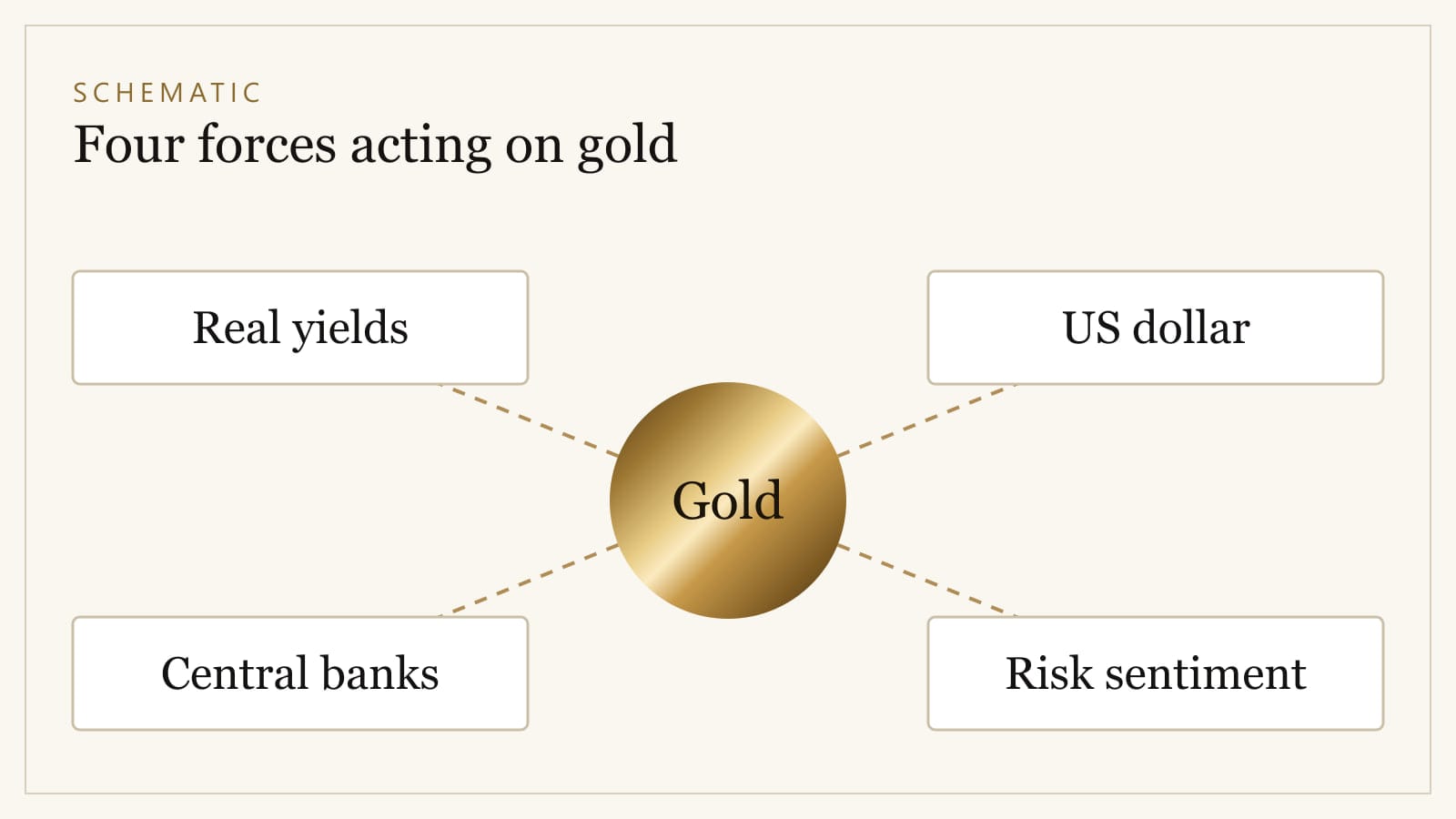
- Real interest rates. Gold pays no interest. When inflation-adjusted bond yields rise, holding gold costs more in forgone income, and demand has tended to soften. When real yields fall, that cost shrinks.
- The US dollar. Gold is priced in dollars, so a stronger dollar makes it dearer for buyers using other currencies — and it moves the quote directly.
- Central bank demand. Central banks hold gold as a reserve asset and can buy or sell in size for reasons that have nothing to do with a chart.
- Risk sentiment. Under stress some investors move toward gold as a store of value, although in a scramble for cash it can be sold along with everything else.
These relationships are tendencies, not laws. Each has held for long stretches and broken down for others. What moves the price of gold looks at each force, and at why single-cause explanations of a move are usually written after it has happened.
How traders read a gold chart
A chart does not tell you what will happen next. It organises what has already happened so that you can form a view and — just as important — know when that view is wrong.
Two ideas carry most of the weight early on:
- Trend structure. A market making higher highs and higher lows is behaving differently from one making lower highs and lower lows, and both differ from a range. Reading a gold market trend shows how to see that structure and what breaks it.
- Support and resistance. Areas where price has repeatedly turned tend to matter again, but on gold they behave like zones rather than exact lines. The explainer on support and resistance in gold covers why, and how traders use them to mark where an idea stops making sense.
The natural next question is how anyone decides whether to buy or sell at all. That is a matter of process rather than prediction, and how traders analyse market direction sets the process out step by step.
Why gold needs more respect than it looks
Gold's reputation as a safe haven says nothing about how it trades. Regulators treat it as more volatile than the major currency pairs — European rules, which set retail leverage limits according to the volatility of the underlying, allow less leverage on gold than on the majors — and it can move sharply around US economic data, central bank decisions and geopolitical headlines.
Add leverage and the arithmetic changes fast. Leverage lets a small deposit control a much larger position, so a move that would be unremarkable in an unleveraged holding can be a large share of an account. Losses scale in exactly the same proportion as gains.
This is where most beginners go wrong, and the fix is not a better entry. It is sizing. Risk management for gold traders walks through the arithmetic, and the principle fits in one sentence: decide how much you accept losing and where your idea is invalidated, then let those two things determine your position size.
The costs that come with every trade
Every trade starts slightly behind. The main costs are:
- The spread — the gap between the buying and selling price. On gold it can widen noticeably around major news and in quieter hours.
- Commission — charged per trade on some account types instead of, or as well as, a wider spread.
- Overnight financing — often called swap: a charge or credit for holding a leveraged position past the daily rollover.
- Slippage — the difference between the price you asked for and the price you received, most common when the market is moving quickly.
Costs weigh more heavily the shorter you hold a position, which is a large part of why gold scalping is so much harder than it appears.
Where the platform fits in
If your broker provides MetaTrader 5, the platform will not make decisions for you, but it holds information you need before placing a trade: the contract size, the smallest price increment, the trading hours and the financing terms. These vary between brokers and sometimes between account types. How XAUUSD works on MetaTrader 5 shows where each one lives.
A sensible order of learning
If gold is new to you, this sequence avoids most of the expensive surprises:
- Understand the instrument — what XAUUSD is, and how your product defines a lot.
- Understand the drivers — well enough to explain why gold moved, even if you could not have predicted it.
- Learn to read structure — trends, ranges, and support and resistance as zones.
- Learn the arithmetic of risk before you learn entries.
- Read the mistakes beginners most often make, because most of them are avoidable.
- If you already trade currencies, read how gold differs from forex before carrying your habits across.
None of this makes trading safe. It makes the risks visible, which is the most any education can honestly offer.
Sources and references
- Market Watch — MetaTrader 5 Help — MetaQuotes LtdOfficial documentation · retrieved 21 September 2026
- Gold Demand Trends: Q4 and Full Year 2025 — Central Banks — World Gold CouncilIndustry body · retrieved 21 September 2026
- Gold demand: the role of the official sector and geopolitics (The international role of the euro, June 2025) — European Central BankCentral bank · retrieved 21 September 2026
- You asked, we answered: explaining gold's recent performance — World Gold CouncilIndustry body · retrieved 21 September 2026
- Conversion Factors for Precious Metal Sales — National Institute of Standards and Technology (NIST)Government · retrieved 21 September 2026
- NIST Handbook 133 (2026), Appendix E: General Tables of Units of Measurement — National Institute of Standards and Technology (NIST)Government · retrieved 21 September 2026
- OTC vs Exchange — Gold Trading — World Gold CouncilIndustry body · retrieved 21 September 2026
- The Global Gold Market — World Gold CouncilIndustry body · retrieved 21 September 2026
- Strategies and tips on navigating the forex spread — IGOfficial documentation · retrieved 21 September 2026
- Understanding forex spreads — IGOfficial documentation · retrieved 21 September 2026
- ESMA adopts final product intervention measures on CFDs and binary options — European Securities and Markets AuthorityRegulator · retrieved 21 September 2026
- MetaTrader 5 technical analysis — MetaQuotes LtdOfficial documentation · retrieved 21 September 2026