Gold Trading Risk Management for Beginners
Most accounts are not lost to bad analysis. They are lost to position sizes that turned an ordinary losing trade into a serious one. This is the arithmetic that prevents it.

Key takeaways
- Decide how much of your account you accept losing on a trade before you think about position size.
- Place the stop where the trade idea is proven wrong, then calculate the position size that fits that distance.
- Leverage does not set your risk directly, but high leverage makes oversized positions easy to open.
- Losses compound against you: a 50% drawdown needs a 100% gain just to get back to where you started.
- Stops are not always filled at their level. Gaps and fast markets can make a loss larger than planned.
In this article · 8 sections
The short answer
Managing risk on gold comes down to one sequence, followed every time:
- Decide the maximum amount you accept losing on the trade.
- Find the price at which your trade idea is wrong, and put your stop beyond it.
- Calculate the position size that makes the distance to that stop equal to your maximum loss.
Position size is the output of that process, never the starting point. Almost every account-ending mistake in gold trading involves doing it the other way round.
Start with the loss you accept
Before looking at a chart, decide what a losing trade is allowed to cost. Many educational sources express this as a small percentage of the account per trade, so that a run of losses — which every trader experiences — does not do lasting damage.
This article uses 1% in its example purely to make the arithmetic easy to follow. It is not a recommendation. The right figure depends on your circumstances, and many people choose less.
The reason to decide this first is psychological as much as mathematical. A loss you agreed to in advance is a cost of doing business. A loss you discover mid-trade is a crisis, and crises produce bad decisions.
Stops belong where the idea is wrong
A stop is not a number of dollars you can bear to lose. It is the price at which the reason for the trade no longer holds.
If you are buying because a support zone is holding, the idea is wrong when price breaks clearly below that zone. If you are trading an uptrend, it is wrong when the most recent higher low fails. The explainers on support and resistance and reading a gold trend cover how to find those points.
Gold is volatile, so the stop needs room beyond the level for ordinary noise. That makes gold stops wider than many people expect — and a wider stop, correctly handled, means a smaller position, not a larger loss.
Position size: the calculation
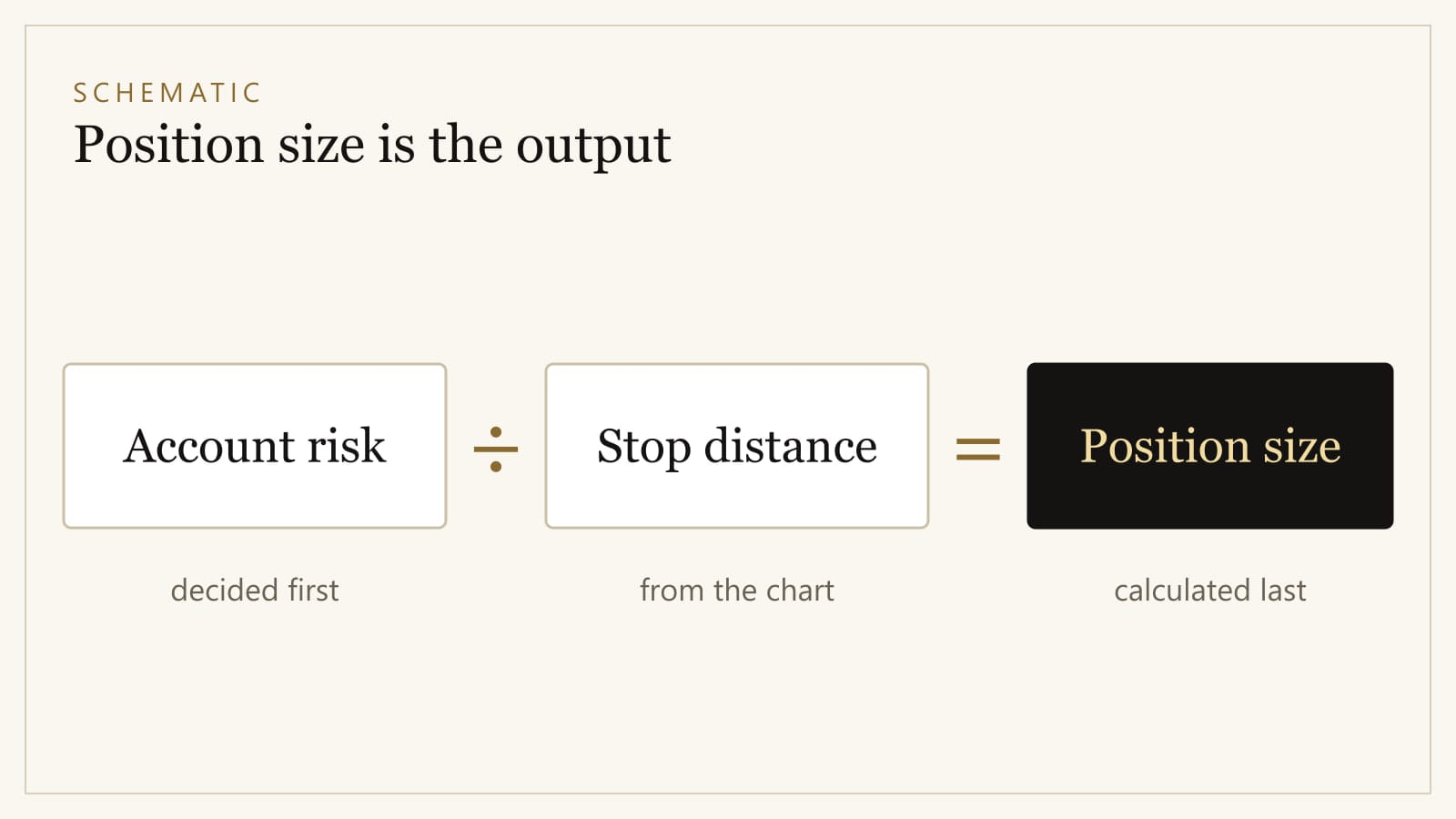
The formula is:
Position size = amount you accept losing ÷ loss per unit of size at your stop
Here is a hypothetical worked example. The figures are chosen to show the method; they are not a suggested account size, risk level or trade.
| Step | Hypothetical figure |
|---|---|
| Account balance | 5,000 |
| Maximum risk on this trade (1%) | 50 |
| Distance from entry to stop | 4.00 per ounce |
| Ounces that risk 50 over that distance | 50 ÷ 4.00 = 12.5 ounces |
| Contract size assumed for this example | 100 ounces per standard lot |
| Position in lots | 12.5 ÷ 100 = 0.125 lots |
| Rounded down to the platform's step | 0.12 lots |
Two details matter:
- Always round down. Rounding up quietly increases your risk above the limit you set.
- Check the contract size on your own platform. The 100-ounce lot above is an assumption for the example. Providers differ, and getting this wrong multiplies every figure after it. How XAUUSD works on MetaTrader 5 shows where to find it.
If the calculation produces a position smaller than the platform's minimum size, the honest answer is that the trade does not fit your risk limit with that stop. Moving the stop closer to make it fit defeats the purpose.
Why leverage is not the same as risk
Leverage determines how large a position your margin allows you to open. It does not, on its own, decide how much you lose — that is set by your position size and where you exit.
In practice the two are closely linked, because high leverage makes it easy to open a position far larger than your risk calculation permits. The danger is not the leverage figure a broker advertises; it is the temptation to use all of it. A second danger is the margin call: if losses reduce your equity far enough, the broker may close positions automatically, at whatever price is available.
The rules depend on where you live and which firm you use. In the European Union, for example, regulators cap retail leverage on gold contracts for difference at 20:1, require providers to close out positions when margin falls to a set level, and require negative balance protection, which limits a retail client’s losses to the funds in their account. Check which protections apply to your own account.
The arithmetic of losses
Losses and recoveries are not symmetrical. After a loss, you are working with a smaller account, so you need a larger percentage gain just to return to where you were:
| Loss | Gain needed to recover |
|---|---|
| 10% | about 11% |
| 20% | 25% |
| 30% | about 43% |
| 50% | 100% |
This is the plainest argument for keeping individual losses small. A string of modest losses is recoverable. One large loss can take a very long time to repair.
News, gaps and stops that slip
A stop-loss order is an instruction, not a promise of price. When the market moves very quickly or jumps from one price to another — around a major data release, or when trading resumes after a weekend — a standard stop may be filled well beyond its level. The loss is then larger than planned.
Ways traders manage that include reducing size or standing aside before high-impact scheduled events, being cautious about holding positions over the weekend, and checking whether their provider offers guaranteed stops and what they cost.
Rules worth considering
Rules only help if they are written before they are needed. Some that traders commonly set for themselves:
- A maximum risk per trade, calculated as above, every time.
- A maximum loss per day or week, after which trading stops until the next period.
- Never widening a stop once a trade is open. Tightening it to reduce risk is different.
- No adding to a losing position.
- A pause after several consecutive losses, to check whether the market has changed or the process has slipped.
None of this makes trading safe, and none of it improves the analysis behind a trade. What it does is keep ordinary losing streaks from becoming account-ending ones. For the mistakes these rules are designed to prevent, see common gold trading mistakes, and for the wider picture, the guide to trading XAUUSD from first principles.
Sources and references
- What is CFD trading and how does it work? — PepperstoneOfficial documentation · retrieved 21 September 2026
- Market Watch — MetaTrader 5 Help — MetaQuotes LtdOfficial documentation · retrieved 21 September 2026
- What is a Guaranteed Stop? — IGOfficial documentation · retrieved 21 September 2026
- ESMA agrees to prohibit binary options and restrict CFDs to protect retail investors — European Securities and Markets AuthorityRegulator · retrieved 21 September 2026
- ESMA adopts final product intervention measures on CFDs and binary options — European Securities and Markets AuthorityRegulator · retrieved 21 September 2026